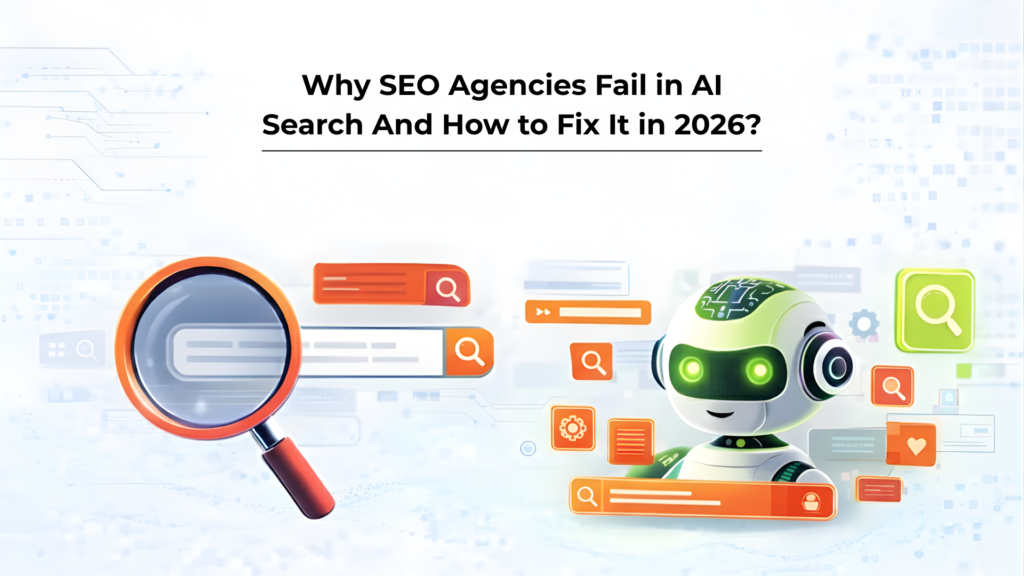
SEO agencies are facing a quiet but serious crisis. Many still report “good rankings,” yet their clients are seeing declining visibility, fewer mentions, and shrinking influence in AI-driven search results. The problem isn’t effort, it’s relevance. Understanding why SEO agencies fail in AI search requires acknowledging that search itself has changed faster than most agencies have adapted.
Search engines are no longer just ranking web pages. AI systems now summarize, compare, and recommend answers directly to users. Platforms powered by large language models decide which brands get cited, referenced, or ignored, often without a single click. Agencies that rely on outdated workflows are running into serious AI visibility issues, even when traditional metrics look healthy. This article explains the real SEO failure reasons behind agency underperformance in AI search, highlights the most common AI search optimization mistakes, and outlines how agencies can fix these problems in 2025.
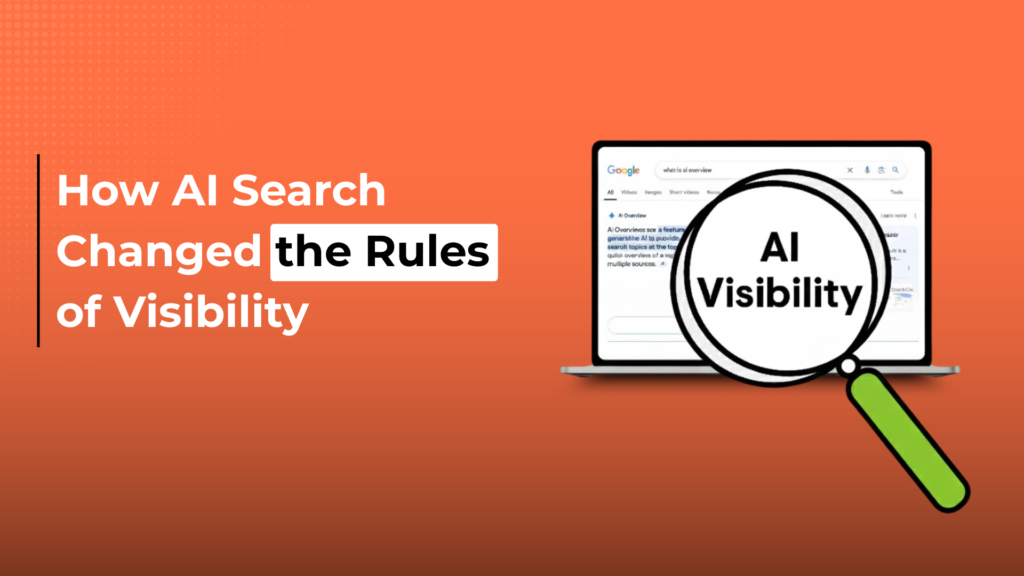
How AI Search Changed the Rules of Visibility
Traditional SEO was built for a search model based on listings and links. Rank high enough, earn clicks, and you win. However, Why SEO Agencies Fail in AI Search becomes clear as AI-driven search systems flip that model entirely. Modern platforms such as Google AI Overviews, ChatGPT, and Google Gemini do not simply show results; they generate answers. These systems evaluate content based on clarity, trust, and completeness, then synthesize information across sources.
This shift means ranking is no longer the primary visibility factor. If an AI system does not understand or trust a brand’s content, that brand disappears from the conversation, even if its pages rank in classic results.
Outdated SEO Strategies Agencies Still Rely On
One of the biggest reasons SEO agencies fail is continued dependence on outdated SEO strategies. Many agencies still prioritize keyword density, exact-match anchors, and volume-based link building without adapting content for AI interpretation.
These tactics were designed for crawlers, not reasoning systems. AI models do not reward content that merely matches a phrase. They reward content that explains concepts, resolves intent, and demonstrates authority across a topic. Agencies stuck in old frameworks optimize pages in isolation, assuming performance is page-specific. AI search evaluates entire knowledge profiles, not individual URLs.
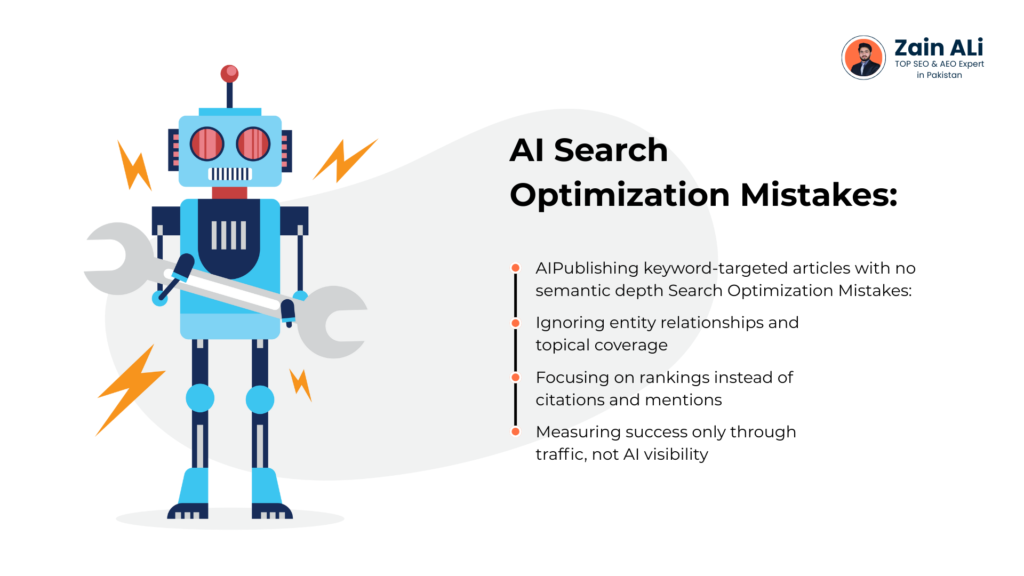
AI Search Optimization Mistakes
A critical AI search optimization mistake is treating AI as a tool, not as a search system. Many agencies use AI to write faster content, but never change the underlying strategy.
Common errors include:
- Publishing keyword-targeted articles with no semantic depth
- Ignoring entity relationships and topical coverage
- Focusing on rankings instead of citations and mentions
- Measuring success only through traffic, not AI visibility
These mistakes lead to content that is indexable but not reusable by AI systems.
SEO Agencies vs AI Search
The clash between SEO agencies vs AI search is structural, not tactical, which clearly explains Why SEO Agencies Fail in AI Search. Agencies are organized around deliverables like rankings, backlinks, and monthly reports. AI search operates on understanding, synthesis, and trust.
AI systems do not care how many links a page has if the explanation is shallow or incomplete. They care whether a source consistently provides accurate, contextual answers across related questions. This mismatch explains why many agencies claim success while clients lose influence in AI-generated results.
Why AI Visibility Issues Go Unnoticed?
One of the most dangerous problems is that AI visibility issues are often invisible in traditional analytics. A site may rank, get impressions, and even attract some traffic, yet never be cited by AI systems.
Most agencies don’t track:
- AI mentions
- Brand inclusion in AI answers
- Citation frequency in AI summaries
As a result, failure is misdiagnosed as “algorithm volatility” instead of structural irrelevance.
Lack of Topical Authority: The Silent Killer
AI search rewards brands that demonstrate topical authority, not just optimization skill. Agencies that publish scattered blogs targeting unrelated keywords fail to build a coherent knowledge footprint.
AI systems evaluate whether a brand:
- Explains a topic comprehensively
- Covers definitions, comparisons, and implications
- Maintains consistency across content
Without this, even well-optimized pages lose selection priority. This is one of the most overlooked SEO failures in 2025.
Human Overconfidence, Strategic Blindness
Ironically, some SEO agencies fail because they underestimate AI. They assume AI is just another algorithm update rather than a paradigm shift.
Others over-automate, letting AI generate content without human strategy, context, or quality control. Both extremes lead to failure: either resisting change or adopting it blindly. Successful AI search optimization requires a human-led strategy with AI-assisted execution.
How to Fix SEO Agency Failure in AI Search?
Fixing these issues requires a fundamental reset. First, agencies must move from keyword planning to intent and answer mapping. Content should be designed to answer complete questions, not just target phrases. Second, build topical clusters instead of isolated posts. Demonstrate consistent expertise across an entire subject area so AI systems recognize authority.
Third, optimize content for LLM readability: clear structure, explicit definitions, and logical flow. This enables AI extraction without misinterpretation. Finally, change measurement. Track mentions, citations, and AI visibility, not just rankings and traffic.
The Agencies That Will Survive AI Search
Agencies that adapt will thrive. Those that don’t will continue losing relevance while reporting “success.” Winning agencies in 2025 will:
- Combine traditional SEO foundations with an AI SEO strategy
- Focus on trust, clarity, and topical depth
- Treat AI systems as audiences, not tools
The future belongs to agencies that help clients become the best answers, not just optimized pages.
Conclusion:
The reality behind why SEO agencies fail in AI search is uncomfortable but clear: the rules of visibility have changed, and many agencies are still playing the old game. AI-driven search doesn’t reward effort, output volume, or even rankings alone; it rewards understanding, trust, and usefulness. Agencies that continue to rely on outdated SEO strategies are not failing because SEO is dead, but because their approach no longer matches how search works.
What makes this failure especially dangerous is that it often goes unnoticed, highlighting why SEO Agencies Fail in AI Search. Rankings may still exist, reports may still look positive, and traffic may not collapse overnight. Yet behind the scenes, brands are losing relevance in AI-generated answers, summaries, and recommendations. These AI visibility issues quietly erode long-term authority, making recovery harder the longer agencies delay adaptation. The fix is not switching tools or producing more content; it’s a strategic reset. Agencies must stop treating AI as a content shortcut and start treating AI systems as new decision-makers. Avoiding common AI search optimization mistakes means shifting from keyword obsession to intent clarity, from isolated pages to topical authority, and from traffic-only metrics to real AI visibility signals.