An effective on-page SEO guide is essential for anyone looking to improve search visibility through content and website optimization. On-page SEO refers to all the actions taken directly within a webpage to help search engines understand its relevance and value. These optimizations influence how pages rank, how users engage, and how search engines interpret content quality.
Unlike off-page SEO, which focuses on backlinks and external signals, on-page SEO is fully within your control. It includes elements such as content quality, keyword placement, headings, internal linking, URLs, and image optimization. Search engines like Google analyze these signals to determine whether a page deserves higher visibility for a specific query.
This on-page seo guide is designed to walk you through proven methods that align with modern search engine guidelines. From understanding search intent to structuring content for readability and relevance, the on-page SEO guide forms the foundation of sustainable rankings. When implemented correctly, it not only improves organic traffic but also enhances user experience, engagement, and overall site performance.
What Is On-Page SEO?
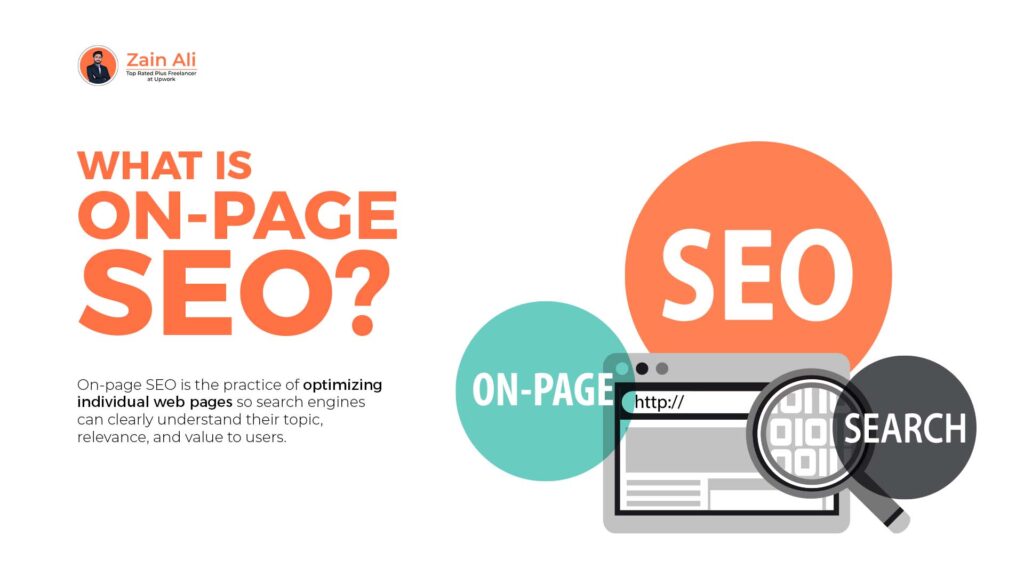
To understand this on-page seo guide, you first need clarity on what an on-page SEO guide actually is and how it functions. On-page SEO is the practice of optimizing individual web pages so search engines can clearly understand their topic, relevance, and value to users. It focuses on elements you control directly on the page, such as content quality, keyword usage, headings, URLs, internal links, and media optimization.
So how does it work in practice? Search engines like Google analyze on-page signals to decide whether a page satisfies search intent. When your content matches what users are looking for and is structured correctly, search engines can crawl, index, and rank it more accurately. This is why keyword placement, semantic relevance, and clear page structure matter.
An effective on-page seo guide also emphasizes user experience. Fast-loading pages, readable formatting, and logical navigation all support better engagement, which indirectly strengthens rankings. On-page SEO guide is not about stuffing keywords; it’s about aligning content with intent while making it easy for both users and search engines to consume. When these elements work together, on-page SEO becomes the foundation of organic visibility. Without it, even strong backlinks or authority signals struggle to produce consistent ranking results.
On-Page SEO vs. Off-Page SEO
A clear on-page seo guide should explain how on-page SEO differs from off-page SEO, as both play distinct roles in search optimization. On-page SEO focuses on elements within your website that you can directly control. This includes content quality, keyword placement, headings, internal links, URLs, and images. These factors help search engines understand what your page is about and how well it satisfies user intent.
Off-page SEO, on the other hand, refers to actions taken outside your website to build authority and trust. This mainly includes backlinks, brand mentions, and external signals that indicate credibility. Search engines like Google use off-page signals to assess how trustworthy a site is compared to competitors, but they still rely on on-page signals to interpret relevance.
Why On-Page SEO Is Important for User Experience?
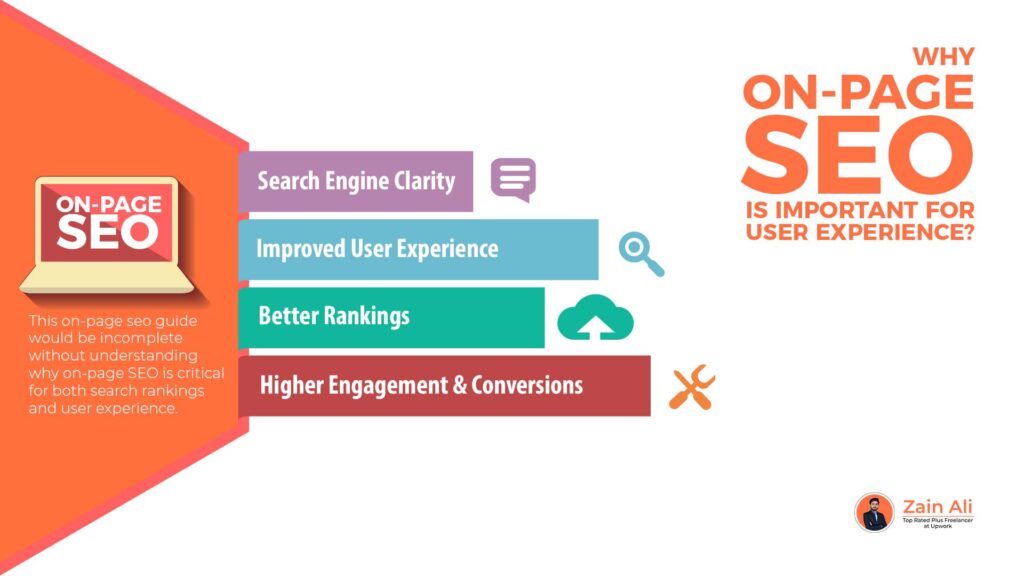
This on-page seo guide would be incomplete without understanding why on-page SEO is critical for both search rankings and user experience. On-page SEO acts as the communication layer between your content and search engines. It helps search engines determine relevance, context, and quality, which directly influences how pages are ranked in search results. Search engines like Google aim to deliver the best possible answers to users.
When a page is well-optimized, with clear headings, relevant keywords, structured content, and fast loading times, it becomes easier for search engines to interpret and rank it accurately. Pages that lack on-page optimization often struggle to rank, even if they have strong backlinks. From a user experience perspective, on-page SEO improves readability, navigation, and engagement. Proper formatting, logical content flow, and optimized media make it easier for visitors to find information quickly.
Search Intent
Search intent is the backbone of every effective on-page seo guide because it defines why a user performs a search and what result will satisfy them. Modern search engines don’t just match keywords; they evaluate intent. Understanding whether a query is informational, navigational, commercial, or transactional helps you shape content that actually meets user expectations. Search engines like Google analyze signals such as content depth, structure, and engagement to determine if a page fulfills intent.
If your page targets the right keyword but delivers the wrong type of content, rankings will suffer. For example, a how-to query expects step-by-step guidance, while a comparison query expects pros, cons, and alternatives. From an on-page perspective, intent influences headings, content format, internal links, and even media usage. Pages that clearly answer the user’s core question, early and thoroughly, tend to perform better. This is where on-page optimization becomes strategic rather than mechanical.
Keyword Research and Implementation
Keyword research and implementation are core pillars of any effective on-page seo guide. The goal isn’t just to find popular terms, but to identify keywords that closely match search intent and can realistically be ranked with high-quality content. Strong keyword research connects what users are searching for with how your page is structured and written. Start by identifying a primary keyword for each page, then support it with closely related terms and variations. This helps search engines understand topical relevance without forcing repetition.
Tools and data from platforms like Google reveal how users phrase queries and what type of content ranks. Analyzing top-ranking pages also shows keyword placement patterns and content depth expectations. Implementation matters as much as selection. Primary keywords should appear naturally in the title tag, URL, headings, and early content, while secondary terms can be distributed throughout the body. Avoid keyword stuffing; modern algorithms favor semantic relevance over raw frequency.
On-Page SEO Checklist
An actionable on-page SEO checklist helps ensure no critical optimization step is missed. In this on-page seo guide, the checklist focuses on elements that directly influence relevance, crawlability, and user engagement. Start with content: it should be original, helpful, and aligned with search intent. Clear answers early on improve satisfaction and reduce bounce rates. Next, optimize your title tag and meta description to accurately reflect the page topic and encourage clicks. Use headings (H1–H3) to create a logical structure that guides readers and search engines through the content.
URLs should be concise, descriptive, and readable. Internal links should connect related pages to distribute authority and improve navigation. Images are another key item; use descriptive file names, compressed sizes, and relevant alt text to support accessibility and image search. Check external links to ensure they point to credible sources and open in new tabs where appropriate. Page speed and mobile responsiveness are non-negotiable; slow or broken layouts hurt rankings and experience.
On-Page SEO Best Practices
Applying on-page SEO guide best practices to content and metadata ensures your pages are both relevant to search engines and compelling to users. In this on-page seo guide, the priority is clarity, accuracy, and intent alignment. Start with content that answers the primary query comprehensively. Use a clear H1, supportive subheadings, and logical flow so readers can scan and understand the page quickly. Metadata plays a crucial role in visibility and click-through rates.
Title tags should be concise, descriptive, and accurately reflect the page topic, while meta descriptions should summarize value and encourage clicks without keyword stuffing. Consistency between titles, descriptions, and on-page headings helps search engines interpret relevance more confidently. Content formatting also matters. Short paragraphs, bullet points, and highlighted key ideas improve readability. Place important information early, and expand with examples and supporting details. Internal links should be contextually relevant, guiding users to deeper resources while distributing authority across the site.
On-Page SEO Techniques for URLs, Images, and Internal Links
Mastering technical elements is a key part of any effective on-page seo guide, and URLs, images, and internal links play a major role in how search engines evaluate page quality. These elements may seem minor individually, but together they strongly influence crawlability, relevance, and user experience.
URLs should be short, descriptive, and easy to read. A clean URL structure helps users understand what a page is about before clicking and helps search engines categorize content accurately. Avoid unnecessary parameters, numbers, or stop words. Including the main topic naturally in the URL improves clarity without over-optimization. Image optimization is another essential on-page technique. Use compressed images to improve page speed, descriptive file names, and meaningful alt text to support accessibility and image search. Proper image optimization ensures visual content enhances rather than slows down the page.
Internal linking connects related content across your website, guiding users and distributing authority. Contextual internal links help search engines understand page relationships and topic depth. Search engines like Google use internal links to discover pages and assess importance within a site’s structure. When URLs are clean, images are optimized, and internal links are strategically placed, the on-page SEO guide becomes more efficient. These techniques strengthen usability and indexing, making them essential components of a high-performing on-page optimization guide strategy.
Advanced On-Page Optimization
On-page Seo techniques take this on-page seo guide beyond basic improvements and help pages compete in more demanding search results. Once content and structure are solid, elements like schema markup, page speed, and user experience (UX) become critical ranking and visibility factors. Schema markup provides search engines with structured data that explains page content more clearly. By adding schema, you help search engines display rich results such as FAQs, reviews, and breadcrumbs.
These enhancements can improve click-through rates by making listings more visually informative. While schema doesn’t guarantee higher rankings, it supports better interpretation and presentation in search results. Page speed is another advanced factor that directly affects both rankings and usability. Slow-loading pages frustrate users and increase bounce rates. Search engines like Google prioritize fast, mobile-friendly pages because they deliver better user experiences.
Measuring and Maintaining SEO Performance
A complete on-page optimization guide doesn’t end after implementation; measuring and maintaining performance is what turns optimization into long-term results. Once changes are live, you need to track how pages perform in search results and how users interact with them. This ongoing process ensures your on-page seo guide stays effective as algorithms and user behavior evolve. Start by monitoring organic traffic, keyword rankings, and engagement metrics such as time on-page and bounce rate.
Tools like Google Analytics and Google Search Console help identify which pages are improving and which need refinement. Look for patterns, pages that gain impressions but few clicks may need better titles or meta descriptions. Maintenance is just as important as measurement. Regularly update content to keep it accurate, refresh outdated sections, and improve internal linking as your site grows. Page speed, mobile usability, and structured data should also be reviewed periodically to prevent technical decay.
Search engines like Google favor websites that stay current and consistently deliver value. By measuring results and making incremental improvements, on-page SEO becomes a continuous growth cycle. This disciplined approach ensures your optimization efforts remain aligned with user needs and search engine expectations, supporting stable rankings and long-term visibility.
Common On-Page SEO Mistakes to Avoid
Even with a detailed on-page seo guide, many websites struggle because of avoidable on-page SEO mistakes. One of the most common errors is keyword stuffing. Overusing keywords disrupts readability and can trigger negative signals with search engines. Modern algorithms prioritize natural language and relevance over repetition, so keywords should always fit contextually. Another frequent mistake is ignoring search intent. Pages may target the right keyword but fail to deliver the type of content users expect.
This leads to high bounce rates and weak engagement. Poor content structure, long blocks of text, missing headings, or unclear flow also hurt both users and search engines. Metadata issues are equally damaging. Duplicate or missing title tags and meta descriptions reduce click-through rates and make it harder for search engines to understand a page’s purpose. Slow-loading pages and unoptimized images further degrade user experience, especially on mobile devices.
Search engines like Google actively demote pages that provide poor performance signals. Lastly, neglecting internal linking limits crawl efficiency and weakens topical relationships across your site. To avoid these mistakes, follow your on-page seo guide consistently, audit pages regularly, and prioritize clarity over shortcuts. Eliminating these errors strengthens relevance, improves usability, and protects your rankings over time.
Conclusion
A strong on-page foundation is the backbone of sustainable organic growth, and this on-page seo guide has shown how every element works together to support rankings and user experience. From understanding search intent and keyword implementation to optimizing content, metadata, URLs, images, and internal links, on-page SEO creates clarity for both users and search engines.
Search engines like Google rely heavily on on-page signals to judge relevance and quality. When pages are well-structured, fast, readable, and intent-focused, they are easier to crawl, index, and rank. More importantly, they deliver real value to users, something modern SEO cannot succeed without.