AI tools have transformed content creation. With platforms like ChatGPT by OpenAI, anyone can generate articles, emails, and marketing copy in minutes. But there’s a growing problem: most AI-generated content sounds exactly like AI. Readers can sense it. Search engines can sense it. And in many cases, AI-generated content lacks the emotional depth, credibility, and natural flow that real human writing has. That’s why learning how to humanize ChatGPT content has become essential in 2026, not just to bypass AI detection but to build real trust with readers. Humanizing AI content is not about tricking systems. It’s about improving quality. This guide explains why ChatGPT content feels artificial, where it fails, and how to transform it into writing that sounds natural, authoritative, and human.
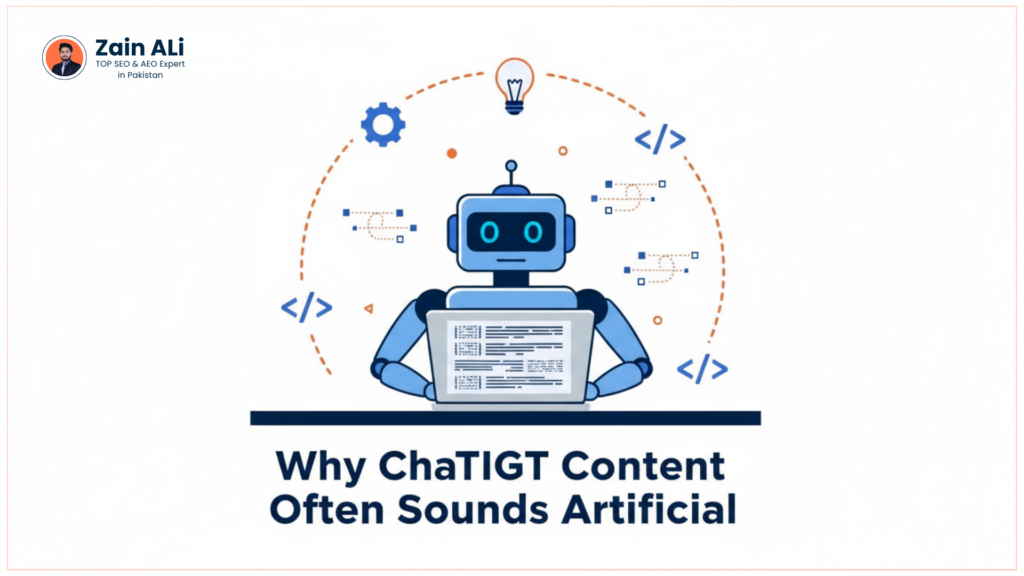
Why ChatGPT Content Often Sounds Artificial?
ChatGPT is trained on massive datasets of existing text. It predicts the most likely next word based on patterns, not lived experience or intent. As a result, its content tends to be:
- Overly balanced and neutral
- Repetitive in structure
- Lacking personal perspective
- Heavy on generic phrases
- Emotionally flat
This doesn’t mean ChatGPT is bad; it means it needs human guidance. Without intervention, AI writing prioritizes correctness over connection, which is the opposite of how humans communicate. Understanding this limitation is the first step in learning how to humanize ChatGPT content effectively.
Human vs AI Writing:
ChatGPT is trained on massive datasets of existing text. It predicts the most likely next word based on patterns, not lived experience or intent. As a result, its content tends to be:
- Overly balanced and neutral
- Repetitive in structure
- Lacking personal perspective
- Heavy on generic phrases
- Emotionally flat
This doesn’t mean ChatGPT is bad; it means it needs human guidance. Without intervention, AI writing prioritizes correctness over connection, which is the opposite of how humans communicate. Understanding this limitation is the first step in learning how to humanize ChatGPT content effectively.
Step 1: Start With Human Intent, Not AI Output
The biggest mistake people make is starting with a finished AI draft and trying to “fix” it. Humanization starts before writing.
Before using ChatGPT, define:
- Who is this written for?
- What emotion should the reader feel?
- What decision should the reader make after reading?
When you prompt ChatGPT with clear human intent, the output improves immediately. Instead of asking for “an article,” ask for an explanation written for a specific person, situation, or problem. This simple shift dramatically improves naturalness.
Step 2: Rewrite the Introduction Like a Human Would Speak
AI introductions are often the most obvious giveaway. They sound polished, formal, and detached. To humanize them:
- Remove generic opening lines
- Add context or tension
- Acknowledge the reader’s situation
- Use conversational phrasing
Humans don’t start by defining a topic; they start by relating to a problem. Always rewrite the intro manually, even if the rest is AI-assisted.
Step 3: Break Predictable Sentence Patterns
ChatGPT tends to produce:
- Even sentence lengths
- Repetitive transitions
- Over-structured paragraphs
Human writing is uneven. Some sentences are short. Others are longer. Thoughts flow naturally, not symmetrically. To humanize ChatGPT content:
- Combine short and long sentences
- Remove repetitive connectors (“Moreover,” “Additionally”)
- Use natural pauses and emphasis
This disrupts the “AI rhythm” readers subconsciously recognize.
Step 4: Add Opinion, Judgment, and Imperfection
AI avoids taking strong positions. Humans don’t. Add:
- Clear opinions
- Strong statements
- Value judgments
- Nuanced disagreement
For example, instead of saying “AI content can be useful in many cases”, say “AI content is useful, but only when humans take control of it.” Opinion is one of the strongest human signals.
Step 5: Use Real Examples and Experience-Based Language
AI explains concepts. Humans explain experiences.
Humanize content by adding:
- Real-world scenarios
- Practical consequences
- “What usually happens” explanations
- Common mistakes people make
Even hypothetical examples feel more human than abstract explanations. AI struggles to create lived realism; this is where you outperform it.
Step 6: Edit for Meaning, Not Grammar
AI-generated content is grammatically clean but semantically shallow. Human editing should focus on:
- Removing redundant explanations
- Tightening weak arguments
- Clarifying vague points
- Replacing filler with insight
Don’t ask, “Is this correct?”
Ask, “Would a human actually say this?” That mindset shift is critical for mastering how to humanize ChatGPT content.
Step 7: Add Entity Awareness for Credibility
Human content references real tools, platforms, and concepts naturally. AI often stays abstract unless prompted. Mentioning real entities, like ChatGPT, Google, or Google AI Overviews, adds realism and authority when done naturally. This also improves SEO and AI visibility without sounding forced.
Step 8: Read It Out Loud
If it sounds robotic when spoken, it will feel robotic when read.
Reading AI content out loud instantly reveals:
- Awkward phrasing
- Over-formality
- Unnatural transitions
Humans write for ears as much as eyes. AI doesn’t.
Step 9: Don’t Try to Hide AI
The goal isn’t to “fool” detectors. The goal is to produce better content. Search engines and users don’t penalize AI content; they penalize bad content. Humanization is about quality, not deception. When AI content is genuinely useful, clear, and human-led, detection becomes irrelevant.
Common Mistakes
Many people sabotage their efforts by:
- Using AI detection tools as their main metric
- Over-editing and losing clarity
- Forcing slang unnaturally
- Rewriting without improving meaning
Humanization is strategic editing, not cosmetic rewriting.
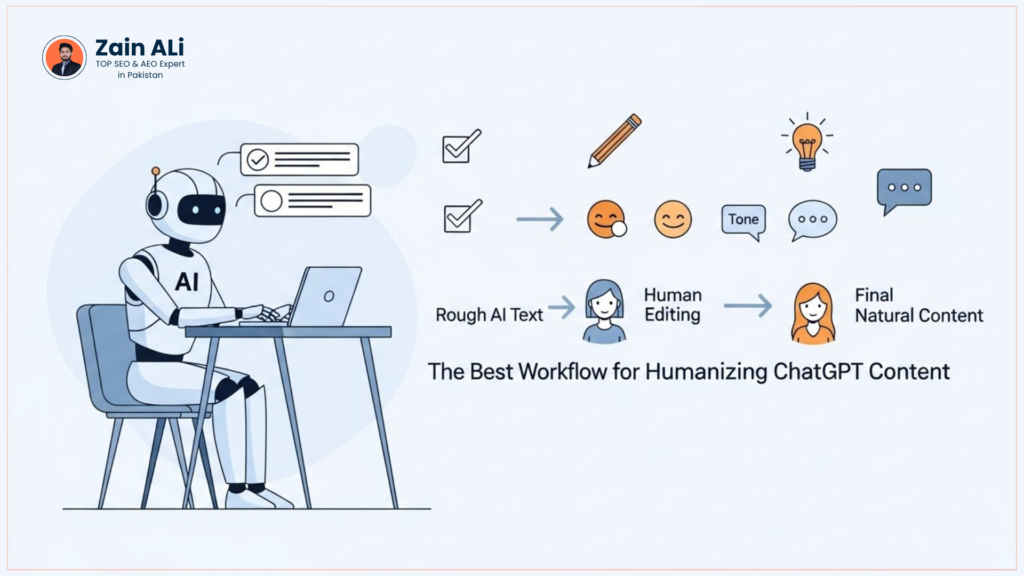
The Best Workflow for Humanizing ChatGPT Content
The most effective approach is hybrid:
- Human defines intent and outline
- ChatGPT drafts sections
- Human rewrites introductions and conclusions
- Human injects opinion, examples, and flow
- Final pass focuses on tone and clarity
AI accelerates. Humans decide.
Conclusion:
Understanding how to humanize ChatGPT content is about more than improving tone, it’s about protecting long-term credibility in a world saturated with AI-generated text. As more content is produced by machines, human quality becomes the real differentiator. The brands and creators who stand out in 2026 are not those who avoid AI, but those who use it intelligently. AI excels at speed, structure, and pattern recognition. Humans excel at meaning, judgment, and emotional resonance. When these strengths are combined, content becomes both efficient and authentic. Humanization is the process of adding what AI cannot: opinion, experience, context, and intent.
Search engines and AI-driven discovery systems don’t reward content just because it’s generated quickly; they reward content that answers real questions clearly and responsibly. Readers don’t engage with text because it’s perfect; they engage because it feels relevant and real. Humanizing ChatGPT content aligns with both of these truths. In the long run, the goal is not to make AI writing invisible but to make it valuable. Human-led AI content builds trust, improves comprehension, and supports sustainable SEO performance. In an AI-powered content era, the winners will be those who remember a simple rule: technology can help you write, but only humans can make writing matter.