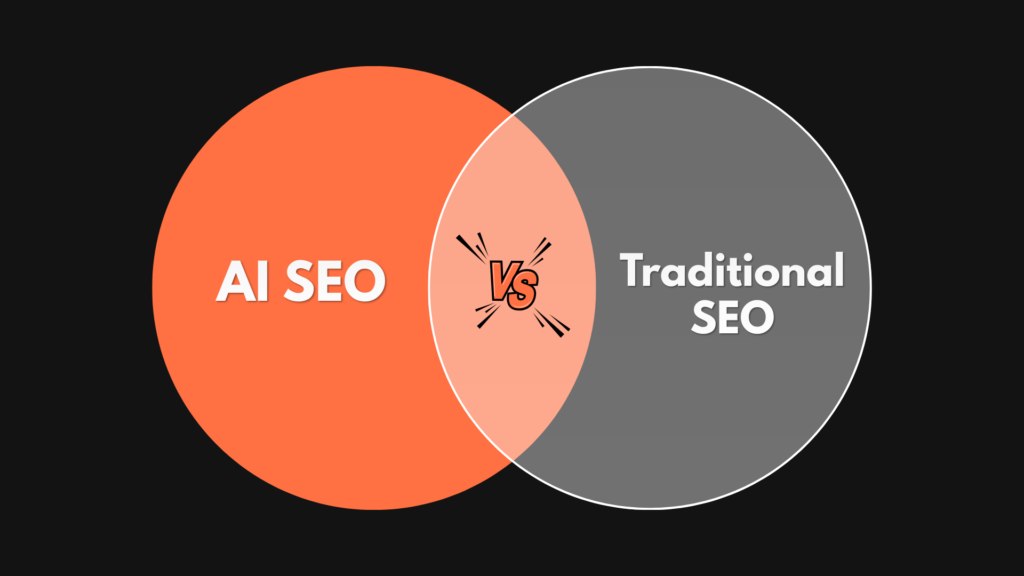
Search engine optimization has always evolved, but the shift happening now is structural, not incremental. To understand AI SEO vs traditional SEO, you must first understand what search engines are becoming. Traditional SEO was built for systems that ranked pages. AI-driven search systems now generate answers.
Traditional SEO operates on a familiar model: keywords are researched, pages are optimized, backlinks are built, and rankings are tracked. Visibility depends on where a page appears in search results. This model worked when users clicked links to find answers. AI-driven search changes that behavior entirely. Platforms powered by large language models, such as ChatGPT, Google Gemini, and Google AI Overviews, do not simply list websites. They interpret content, synthesize information, and present direct answers.
This is the core reason traditional SEO is losing effectiveness. Ranking alone no longer guarantees visibility. If an AI system does not understand, trust, or select your content, your page may never be seen, even if it technically ranks. AI SEO emerges as a response to this shift. Instead of optimizing for search engines as crawlers, AI SEO optimizes for search engines as reasoning systems. It focuses on clarity, authority, entity relationships, and answer-ready content that AI models can confidently reuse.
In short:
- Traditional SEO optimizes for positions
- AI SEO optimizes for selection
Understanding this distinction is the foundation of AI SEO vs traditional SEO for everything that follows.
How Traditional SEO Actually Works?
Traditional SEO was designed for a search environment where engines acted primarily as indexers and rankers. Pages were crawled, keywords were matched, and results were ordered based on relevance and authority signals. If you ranked high enough, users clicked, simple, measurable, and predictable. This model shaped how agencies, tools, and strategies evolved for over a decade. At its core, traditional SEO follows a linear workflow. Keyword research identifies demand, pages are optimized around those keywords, backlinks are built to increase authority, and rankings are tracked to measure success. The assumption is straightforward: higher rankings equal more traffic, and more traffic equals business value. This system still functions within classic search results on platforms like Google, but it no longer defines the entire search experience.
The breaking point appears when search engines stop being just gateways and start becoming answer engines. AI-driven systems, such as Google AI Overviews and conversational tools like ChatGPT, do not reward pages simply for ranking well. They extract, compare, and synthesize information across many sources to generate a single response. In this context, a page optimized purely for keywords can be invisible even if it ranks. Traditional SEO breaks because it optimizes for retrieval, while AI search optimizes for interpretation. Keyword-focused pages often lack the depth, structure, and semantic clarity that AI models need to confidently reuse information. AI systems look for explanations, cause-and-effect reasoning, definitions, comparisons, and consistency across topics. Thin content designed to target a phrase rather than explain a concept provides little value to a reasoning model.
How AI SEO Changes the Workflow?
AI SEO fundamentally rewires how optimization work is planned, executed, and measured. In traditional workflows, the process ends when a page ranks. In AI-driven search, ranking is only a prerequisite; selection is the real goal. AI systems don’t ask, “Which page ranks highest?” They ask, “Which source best explains this?”
The AI SEO workflow starts with intent decomposition, not keyword lists. Instead of targeting dozens of variations of a phrase, AI SEO identifies the core questions users ask and the sub-questions AI models must resolve to answer them. This shifts content planning from keyword mapping to answer mapping, defining what explanations, comparisons, definitions, and caveats must exist for an AI to feel confident. Next comes entity-first structuring. AI models reason through entities and relationships, so content is organized around concepts, not phrases. Clear definitions, scoped sections, and consistent terminology help AI systems understand what your brand knows and how topics connect. This is critical for visibility inside systems like Google AI Overviews, where answers are synthesized from multiple sources.
Content creation itself also changes. AI SEO favors answer-first writing: concise explanations up front, followed by supporting depth. Pages are written to be extractable, with clean headings, logical progression, and unambiguous statements, so AI can reuse information without distortion. This is where LLM SEO optimization matters most: writing for understanding, not just for crawlers. Authority building shifts as well. Instead of chasing isolated backlinks, AI SEO focuses on topical authority, covering a subject comprehensively across a cluster of pages. Consistency across these pages signals expertise and trust. When AI systems evaluate sources, they prefer brands that demonstrate sustained, coherent knowledge rather than one-off optimized posts. To get my SEO services, visit my seo services page.
Where AI SEO Outperforms Traditional, Manual SEO Methods?
AI SEO doesn’t just enhance traditional SEO workflows; it outperforms them in specific, structural ways. This is not about speed alone. It’s about how AI-driven systems evaluate information, detect patterns, and select sources at scale. Understanding where AI SEO has the upper hand explains why traditional, manual SEO struggles in AI-driven search environments.
AI Understands Context Faster Than Keywords Ever Could
Traditional SEO relies on humans mapping keywords to pages and guessing intent based on search volumes. AI SEO operates at a different level. Large language models analyze context, relationships, and meaning across massive datasets instantly. They don’t just see words; they understand how concepts relate.
This allows AI systems to identify the best explanation, not just the closest keyword match. Pages optimized only around keyword placement often fail here, while well-structured, concept-driven content wins selection.
AI Scales Semantic Analysis Beyond Human Capacity
Manual SEO teams can analyze competitors and topics, but only to a limited depth. AI SEO leverages models that process thousands of documents simultaneously, identifying recurring themes, missing explanations, and contradictory statements.
This is why AI-powered search systems like Google AI Overviews consistently surface sources that explain topics holistically. AI favors content that fits into a broader semantic network, something manual optimization cannot replicate at scale.
AI Excels at Answer Synthesis, Not Page Ranking
Traditional SEO assumes users will click through multiple pages to form an understanding. AI systems remove that friction by synthesizing answers directly. This is where AI SEO clearly outperforms manual methods.
If your content contributes a clear, reusable explanation, AI can extract and merge it into a final answer. Manual SEO strategies that rely on ranking tricks or partial explanations fail because they are not answer-complete.
AI Detects Topical Authority, Not Isolated Optimization
Manual SEO often optimizes pages in isolation. AI SEO benefits brands that demonstrate consistent expertise across a topic cluster. AI systems track how often a brand explains related concepts accurately over time.
This means AI rewards patterns of knowledge, not one-off successes. A single well-ranked page is weak compared to a network of coherent, aligned content. This is an area where traditional SEO workflows consistently fall behind.
AI Reduces Dependency on Human Guesswork
Manual SEO decisions often rely on assumptions: which keywords will convert, which pages Google prefers, which links will matter. AI SEO reduces this uncertainty by aligning content with how AI systems actually reason.
Instead of guessing what might rank, AI SEO focuses on what an AI needs to confidently answer a question. This precision is why AI-driven optimization consistently outperforms manual methods in modern search environments.
Where Human-Led SEO Still Wins?
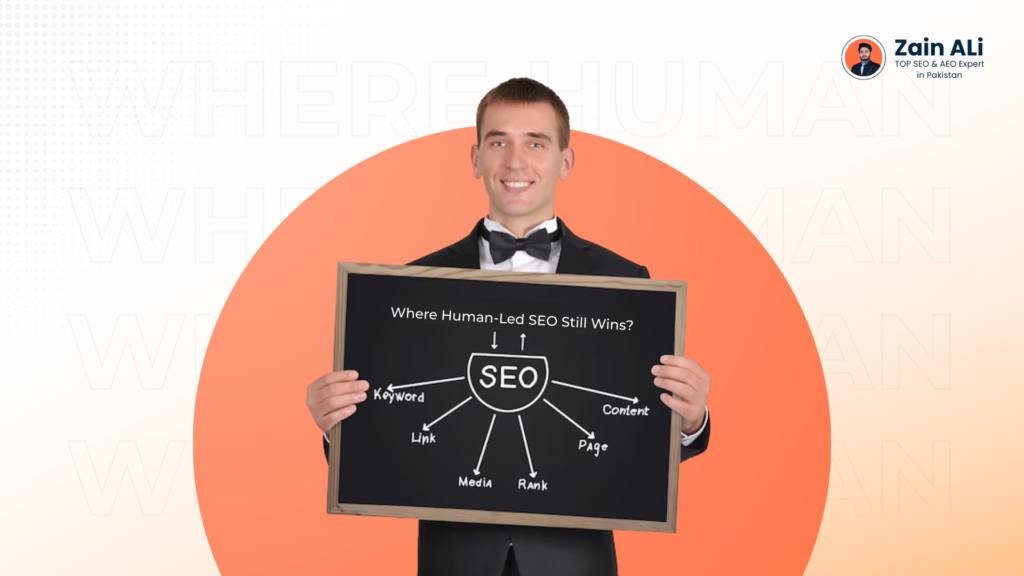
Despite the rapid rise of AI-driven search and automation, human-led SEO still holds critical advantages that AI alone cannot replace. Understanding where human judgment outperforms automation is essential for building a balanced strategy in the AI SEO vs traditional SEO era.
Strategic Judgment and Business Context
AI systems excel at processing information, but they lack real-world business context. Human SEO experts understand brand positioning, commercial intent, and market nuance, factors that strongly influence what content should exist and how it should be framed. Decisions like prioritizing revenue-driving pages, aligning content with sales funnels, or handling sensitive industries require judgment that AI cannot independently apply.
Original Insight, Opinion, and Thought Leadership
AI models synthesize existing information; they do not create new insight. Human-led SEO wins when content requires original thinking, expert opinion, or first-hand experience. Thought leadership pieces, case studies, strategic viewpoints, and industry commentary are areas where human expertise becomes a decisive trust signal, AI SEO vs traditional SEO for users and AI systems evaluating authority.
Ethical, Legal, and Brand-Safety Decisions
SEO often involves gray areas, claims, compliance, regulated topics, or reputational risk. Humans are essential for deciding what should not be said, how to phrase sensitive information, and how to maintain ethical standards. AI can assist, but responsibility and accountability remain human functions.
Creative Framing and Emotional Resonance
While AI can generate structured explanations, humans still outperform in storytelling, persuasion, and emotional framing. Content that connects with users, through tone, empathy, or narrative, builds brand trust and memorability. These qualities influence engagement and long-term authority in ways AI cannot fully replicate.
Interpreting Ambiguous or Emerging Topics
When topics are new, controversial, or poorly defined, AI systems often lack reliable consensus. Human-led SEO excels at sense-making, interpreting incomplete data, reconciling conflicting sources, and explaining uncertainty clearly. This is especially valuable in fast-moving fields where the “right answer” is still evolving.
Conclusion:
The comparison between AI SEO vs traditional SEO is no longer theoretical; it reflects how search already works today. Traditional SEO was designed for an era when visibility relied on rankings and clicks. AI-driven search has shifted the goalposts, rewarding brands that can explain, contextualize, and earn trust, rather than just optimizing for keywords. What we see clearly is this: traditional SEO breaks when search engines stop acting like directories and start acting like reasoning systems. Keyword-focused pages, isolated optimizations, and link-heavy strategies struggle to survive when AI models synthesize answers instead of listing pages. These traditional SEO limitations explain why many sites technically rank but fail to gain real visibility.
AI SEO succeeds because it aligns with how modern search engines and LLMs operate. Through AI SEO strategy, LLM SEO optimization, and SEO for AI search engines, brands position themselves as reliable sources worthy of selection, citation, and summarization. Visibility is no longer about being found; it’s about being used by AI systems. At the same time, this shift does not eliminate the need for humans. Human-led SEO remains essential for strategy, originality, judgment, and brand alignment. The real winners in 2025 are not choosing between AI and humans; they are combining both AI SEO vs traditional SEO. AI handles scale and synthesis; humans handle meaning and direction. In the future of SEO, success belongs to businesses that stop chasing rankings alone and start building authority that AI can recognize and trust.