
Search is changing faster than ever, and if you’re still optimizing only for Google’s blue links, you’re already behind. Today’s users are getting answers directly from AI assistants like ChatGPT, Google Gemini, and Perplexity. They’re not scrolling websites… they’re consuming instant, summarized answers. That’s exactly where AEO (Answer Engine Optimization) comes in. It helps your brand become the source that AI tools trust, cite, and pull answers from.
Instead of fighting for a spot on page one, you’re aiming to be included inside AI-generated responses, the new front page of the internet. And as AI search takes over user behavior, ranking in these answer engines becomes a growth advantage. In this guide, you’ll learn how it works, how AI tools choose sources, and exactly what you need to do to rank on ChatGPT, Gemini, and every major AI search platform.
What Is AEO & How It Differs from Traditional SEO
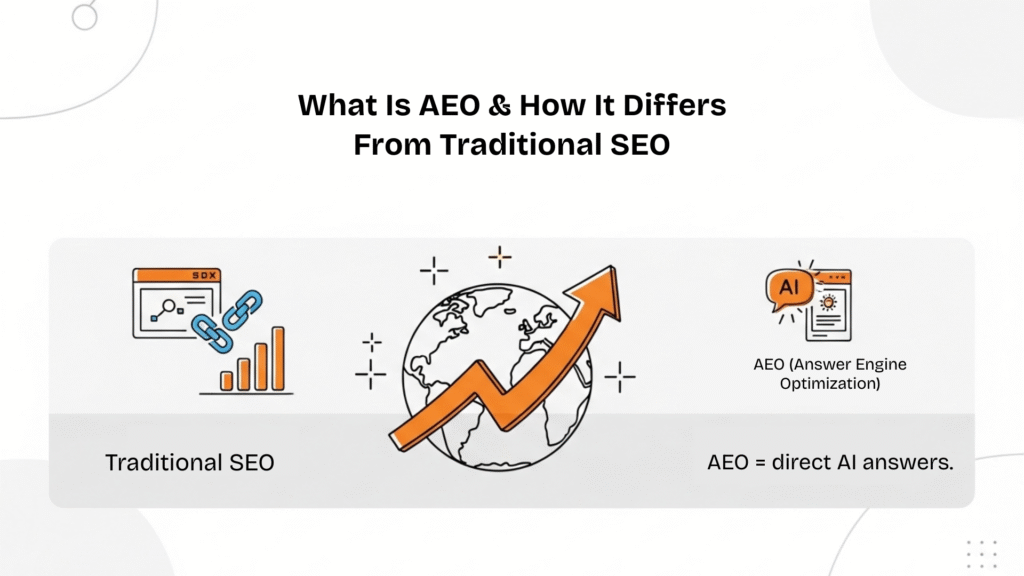
AEO stands for Answer Engine Optimization, and it’s the evolution of classic SEO. Instead of optimizing for clickable blue links, you’re optimizing for answers, the short, accurate, structured responses AI systems use to reply to user prompts. When someone asks ChatGPT, “What’s the best CRM for small businesses?” the model doesn’t show 10 links. It shows one answer. Your goal with AEO is to become that answer.
Traditional SEO focuses on search engines like Google and Bing. it focuses on answer engines, ChatGPT, Gemini, Perplexity, Cand laude, and platforms powered by LLMs. These systems don’t rank websites; they extract information, verify it, and then combine it into one synthesized output. This shift has given rise to generative engine optimization, where brands need structured content, clear entities, and authoritative citations. If the search was about visibility, its about being the trusted source that AI models quote directly.
How AI Search Engines Surface Answers
AI search engines don’t behave like Google; they don’t “rank websites,” they retrieve and assemble information. Large Language Models scan billions of documents, extract the most reliable pieces of data, and then generate a clean, conversational answer for the user. Your goal with AEO is to make your content the easiest, clearest, and most trustworthy source for these models to pull from. LLMs rely heavily on entity clarity, structured information, and factual consistency.
If your brand, product, services, or claims aren’t clearly defined across the web, AI systems struggle to identify you, meaning they won’t cite you. This is where LLM content optimization becomes essential: simplifying explanations, using definitions, adding context, and making your page “AI-friendly” instead of keyword-stuffed. AI tools prefer content that’s short, structured, accurate, and easy to extract. The cleaner your data, the more likely ChatGPT, Gemini, and other AI engines will use it inside their generated answers.
Core Ranking Factors for AEO
Ranking on AI platforms works differently from ranking on Google. AI models don’t care about backlinks alone or keyword density; they care about clarity, structure, authority, and trust. If you want your content to appear inside AI-generated answers, these are the ranking signals you must nail.
Entity Authority
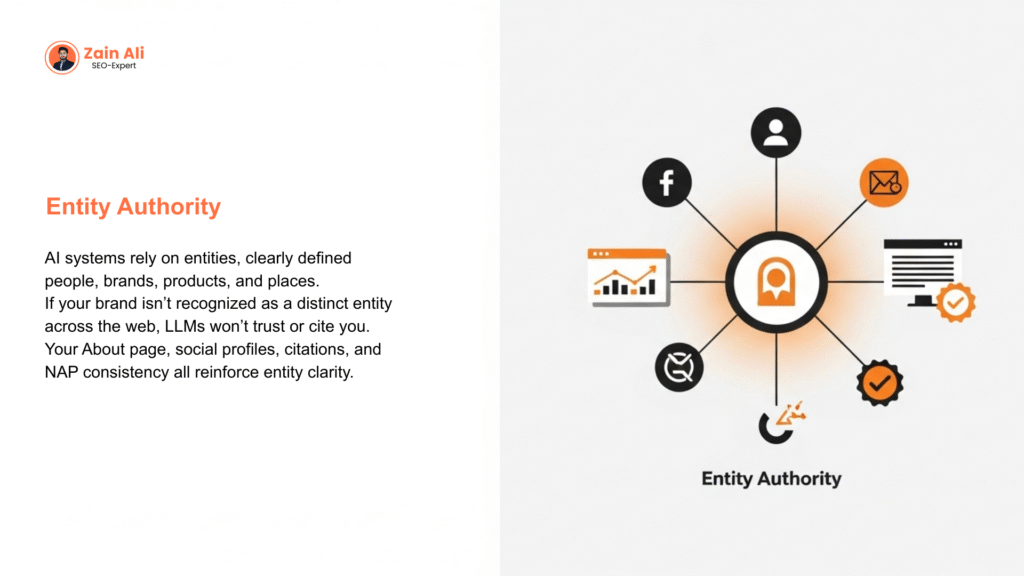
AI systems rely on entities, clearly defined people, brands, products, and places.
If your brand isn’t recognized as a distinct entity across the web, LLMs won’t trust or cite you.
Your About page, social profiles, citations, and NAP consistency all reinforce entity clarity.
Structured, Answer-Ready Content
AI chooses content it can extract easily. That means
- Short definitions
- Clear paragraphs
- Bullet points
- Question-based headers
- TL; DR-style intros
This is where AI search ranking comes from: being the cleanest, fastest source to extract from.
Schema Markup & Technical Signals
Structured data is crucial for AEO because AI models scan the chema to understand context.
Use:
- Article schema
- FAQPage
- Organization
- HowTo schema
Citations & Mentions Across the Web
AI models don’t guess, they cross-check.
They look for:
- Mentions on authority sites
- Data sources
- Stat references
- Brand quotes
When your brand is referenced across reputable sources, AI is more likely to include you.
Freshness, Accuracy, and Topic Consistency
LLMs reward content that is:
- Factually correct
- Recently updated
- Topically consistent
- Supported by authoritative pages
This strengthens AEO and boosts trust signals, making your content the “safe choice” for AI engines.
AEO Strategy: How to Rank on ChatGPT, Gemini & AI Search
If you want your brand to actually appear inside AI-generated answers, not just in Google results, you need a strategy built specifically for how LLMs read, understand, and select information. This is where AEO becomes a competitive weapon. Below is the exact playbook brands are using to get cited by ChatGPT, Gemini, Claude, Perplexity, and every major AI engine.
Build & Strengthen Your Brand Entity
AI systems don’t rank websites; they rank entities. If your brand isn’t clearly defined online, LLMs won’t trust you enough to use your content. What to update your About page with a clear, factual description. Ensure consistent NAP + profiles across the web. Add your brand to directories, databases, and Wikipedia-type platforms if possible. Use internal linking to reinforce who you are and what you do. This establishes the foundation for AEO, helping AI models “understand” your identity.
Write Answer-Focused Content
AI doesn’t extract answers from long, fluffy articles. It pulls from content that’s structured, factual, and easy to scan. Format your content for extraction: Start articles with a 40–60 word answer summary. Use question-based H2/H3 headers. Keep paragraphs short and directUse bullets for clarity. Add definitions, examples, and a short explanation. This is the heart of ChatGPT SE, content built for AI comprehension, not human scrolling.
Add Schema Markup Everywhere You Can
Schema helps AI understand context without guessing.
If you give AI clean, structured data, you increase your chance of inclusion. Use schema types such as: FAQPage, HowTo, Article, OrganizationProduct. This boosts schema for AI search visibility, making your content easier for models to trust and cite.
Build Authority Through Citations & Mentions
AI models cross-check information across the internet.
If your brand appears in trusted sources, you’re far more likely to be included in generated answers. Build citations by: Guest posting on high-authority sites, Getting mentioned in industry news, Publishing original data, statistics, or reports, Participating in podcasts or interviews, Being listed in resource pages or directories. These strengthen AI assistant citations, a major ranking signal for AEO.
Prepare for the Era of Zero-Click AI Answers
In AI search, the user never sees your website. The goal is to be the source behind the answer, not the link. Optimize for this shift: Produce short answers AI can reuse. Add takeaway summaries. Use structured facts + stats. Keep wording clear and authoritative. Update content frequently. Your content must fit directly into zero-click AI answers.
How to Measure AEO Success
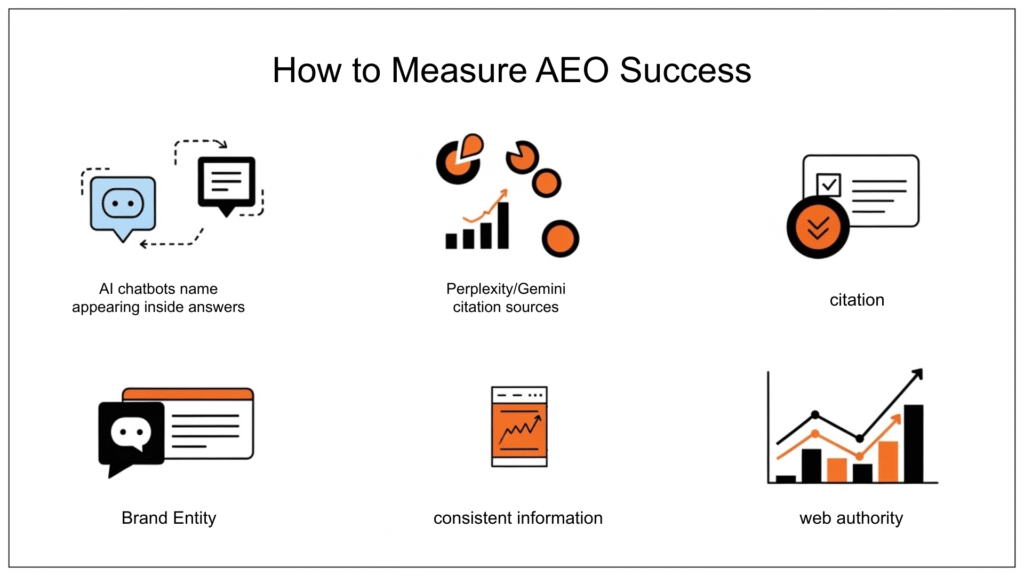
Measuring AEO success is completely different from traditional SEO because you’re not tracking rankings or clicks; you’re tracking how often AI systems actually use your content. The strongest signal of AEO performance is seeing your brand, facts, definitions, or frameworks appear inside answers generated by ChatGPT, Gemini, Claude, and Perplexity. You should regularly test relevant questions inside these AI tools and look for any mention of your business, even if it’s indirect or paraphrased. These appearances are the new version of “position #1.”
Another indicator is whether AI platforms are citing you in their answer summaries. Tools like Perplexity and Google Gemini openly show sources, so if your site appears there, your AEO is working. This is where Google Gemini visibility becomes a direct metric. Beyond citations, you should also observe whether AI systems give consistent, accurate descriptions of your brand. This reflects strong entity recognition, which is essential for AEO. Success is also measured by growing authority across the web. As you publish structured, factual, answer-ready content, you should see more natural mentions, resource-page links, and industry citations, signals AI models rely on heavily.
Common AEO Mistakes to Avoid
Most brands approach AEO with the same mindset they use for traditional SEO, and that’s exactly why they never appear in AI-generated answers. The biggest mistake is writing long, fluffy content that AI engines can’t extract clean facts from. LLMs look for clarity, structure, definitions, and short answer-ready sections. If your content is messy, they’ll ignore it completely. Another major issue is failing to build entity authority. If your brand isn’t consistently defined across the web, AI models won’t understand who you are, and therefore, won’t trust you enough to include your content in responses.
Ignoring the schema is another costly error. Without structured data, AI engines lack the contextual signals they need to identify your expertise. Many businesses also forget to build authoritative citations, assuming backlinks alone are enough. AI search relies heavily on mentions, references, and factual validations across the web. Lastly, focusing only on Google is a mistake. It’s about ChatGPT, Gemini, Claude, Perplexity, and every platform users rely on for instant answers. If your strategy doesn’t cover these channels, you’ll lose visibility fast.
Conclusion
The future of search is shifting from “results” to “answers,” and AEO is the framework that ensures your brand is part of those answers. Instead of competing for traditional rankings, you’re aiming to become a trusted source behind the responses generated by ChatGPT, Gemini, and other AI platforms. Brands that master entity clarity, structured content, schema, citations, and answer-focused writing will dominate the new search landscape, long before their competitors even realize what’s happening.
It isn’t a trend; it’s the next evolution of visibility. The earlier you adapt, the stronger your position becomes as AI-driven discovery continues to grow. This shift is happening faster than businesses expect, so delaying AEO today means losing AI visibility tomorrow. Start optimizing now, before your competitors do.