
Understanding it can significantly simplify your SEO workflow and turn scattered data into clear growth strategies. Developed and popularized by Neil Patel, it has become a widely used SEO platform designed to make search optimization accessible for businesses of all sizes. It combines keyword research, backlink analysis, traffic insights, and site audits into one dashboard. Unlike overly complex enterprise tools, it focuses on usability while still providing meaningful SEO metrics. This makes it particularly valuable for marketers who need actionable insights without technical overwhelm.
Search engines like Google prioritize relevance, authority, and user experience. It helps measure these signals by offering keyword suggestions, competitor analysis, and technical audit reports that align with ranking factors. In this guide, you’ll learn how to use keyword ideas effectively, perform competitor analysis, analyze traffic data, and integrate the Ubersuggest SEO tool into a long-term organic growth strategy.
What Is Ubersuggest?
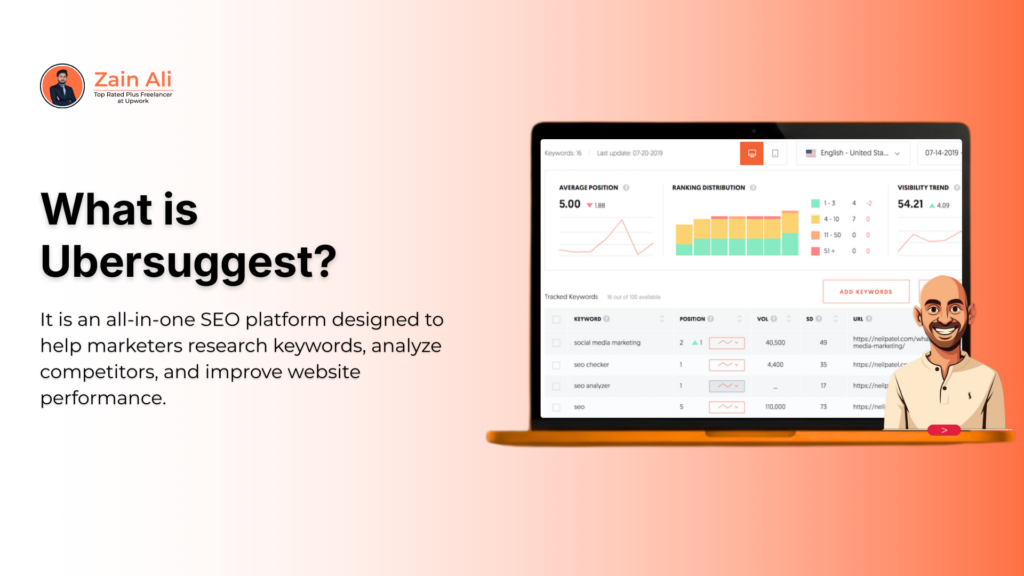
It is an all-in-one SEO platform designed to help marketers research keywords, analyze competitors, and improve website performance. Originally developed as a keyword suggestion tool, it evolved into a complete Ubersuggest SEO tool under the leadership of Neil Patel. Today, it supports keyword research, backlink tracking, traffic estimation, and technical audits in a simplified interface. At its core, it collects search data, backlink metrics, and domain performance insights to provide actionable recommendations. It analyzes keyword difficulty, search volume, cost-per-click (CPC), and seasonal trends. This allows users to identify ranking opportunities based on demand and competition.
It works by scanning websites and indexing keyword and backlink information across the web. It then presents this data through modules such as Keyword Overview, Traffic Analyzer, Site Audit, and Backlinks. Each module focuses on a specific SEO function, enabling a structured optimization workflow. Search engines like Google evaluate authority, relevance, and technical health. It mirrors these ranking factors by providing measurable metrics aligned with search performance. When used strategically, it transforms SEO from guesswork into a guided, data-driven process that supports long-term organic growth.
SEO Tool Overview
The Ubersuggest SEO tool brings multiple optimization features into a single dashboard, making SEO analysis structured and accessible. It is designed to support keyword research, competitor analysis, backlink evaluation, and technical audits without overwhelming users with excessive complexity. One of its primary modules is Keyword Overview, which displays search volume, SEO difficulty, paid difficulty, and CPC. This supports smarter content planning by identifying realistic ranking opportunities. The platform also generates Ubersuggest keyword ideas, including long-tail variations and related search queries, helping build topic clusters aligned with user intent.
Another powerful feature is Traffic Analyzer. Through its traffic analysis, users can estimate competitor traffic, identify top-performing pages, and track keyword positions. This provides insight into what drives organic visibility in a specific niche. The Site Audit module scans websites for technical errors such as broken links, duplicate content, and crawl issues. This ensures foundational SEO health remains intact. Additionally, the Backlinks feature allows monitoring of referring domains and anchor text distribution. Search engines like Google prioritize relevance, authority, and technical stability. By combining these features, it supports all three pillars of SEO in one integrated workflow.
Ubersuggest Keyword Ideas
One of the most valuable features inside it is its ability to generate actionable keyword ideas based on real search behavior. Instead of guessing what users might be searching for, the tool provides structured keyword suggestions tied to search volume, difficulty, and traffic potential. This allows marketers to focus on ranking opportunities rather than chasing broad, highly competitive terms. Within it, the keyword research module displays related keywords, question-based queries, and long-tail variations. These suggestions help uncover low-competition opportunities that align closely with search intent. For SEO-focused strategies, targeting long-tail keywords often produces faster ranking improvements with higher conversion rates.
Each keyword idea includes metrics such as SEO difficulty and estimated organic traffic. By comparing these metrics, users can prioritize keywords that balance demand and ranking feasibility. This transforms keyword research from intuition into measurable decision-making. Search engines like Google reward websites that are relevant and have depth. Grouping related Ubersuggest keyword ideas into topic clusters strengthens topical authority and improves internal linking structure. When applied strategically, it helps build a content roadmap that supports scalable organic growth and consistent improvements in visibility.
Ubersuggest Competitor Analysis
One of the most strategic uses of Ubersuggest is performing structured competitor analysis to uncover why competitors rank higher and how to close the gap. Instead of guessing what works, the platform provides measurable data on keyword positions, traffic trends, and backlink sources. Inside it, the Traffic Analyzer module allows you to enter a competitor’s domain and instantly view estimated organic traffic, top-performing pages, and ranking keywords. This makes traffic analysis a practical way to identify which pages drive the most visibility in your niche. By examining competitor keyword lists, you can discover content gaps, keywords they rank for that you haven’t targeted. This helps refine your keyword strategy and align it with proven search demand. Additionally, reviewing backlink data reveals referring domains that contribute to competitor authority.
Search engines like Google evaluate relevance and authority signals. It competitor analysis provides transparency into these signals, allowing you to replicate successful structures rather than experimenting blindly. Reverse-engineering rankings is not about copying competitors. It’s about understanding patterns, identifying weaknesses, and building a more comprehensive strategy. When applied thoughtfully, it transforms competitor research into a data-driven roadmap for stronger organic positioning.

Ubersuggest Traffic Analysis
A key strength of it lies in its ability to provide structured traffic analysis that helps marketers understand organic growth patterns. Instead of relying solely on internal analytics, the platform estimates competitor traffic and keyword performance using aggregated search data. This makes it easier to evaluate how visibility translates into measurable traffic. Inside it, the Traffic Analyzer module displays estimated monthly visits, top-performing pages, and keyword rankings for any domain. This insight allows you to identify which content drives the most organic traffic in your niche. By reviewing these pages, you can uncover content structures, keyword strategies, and backlink patterns contributing to growth.
Traffic analysis also helps monitor seasonal trends and detect ranking fluctuations. Comparing historical traffic data enables strategic content planning aligned with search demand cycles. When paired with keyword data and backlink metrics, it provides a more complete SEO performance picture. Search engines like Google prioritize relevance and user engagement. Traffic patterns often reflect how well a site satisfies search intent. By leveraging its traffic analysis strategically, you can identify growth opportunities, refine your content roadmap, and ensure your SEO strategy remains aligned with measurable organic performance trends.
How does it compare with Ahrefs and SEMrush?
When choosing SEO tools, many marketers weigh them against platforms like Ahrefs and SEMrush. Though all three help with search optimization, they serve slightly different purposes and audiences. It is known for its simplicity and accessibility, making it an ideal choice for beginners and small business owners who need essentials without complexity. It offers reliable keyword ideas, competitor insights, its traffic analysis, and basic auditing, all visible in one dashboard. For many users, it’s a cost-effective way to start SEO without a steep learning curve.
In contrast, Ahrefs and SEMrush provide more expansive datasets and advanced analysis tools. Ahrefs is widely praised for its extensive backlink index and in-depth ranking research, while SEMrush offers comprehensive marketing analytics, including PPC and social media tools. These platforms are often preferred by experienced SEO professionals handling large sites or competitive niches. It holds its own for foundational SEO tasks, especially keyword discovery and competitor comparisons. However, when deeper backlink intelligence or multi-channel marketing data is required, many users choose to combine tools or upgrade to Ahrefs or SEMrush. Ultimately, the best choice depends on your goals, budget, and how detailed you want your SEO insights to be, whether you need straightforward guidance from it or advanced analytics from premium platforms.
Best Practices
To get maximum value from it, it’s important to use it as part of a structured SEO workflow rather than a one-time research tool. While the platform provides accessible insights, strategic implementation determines whether those insights translate into measurable growth. Start with clear objectives. Whether your goal is increasing traffic, improving rankings, or identifying content gaps, align your research inside it with a specific outcome. Use keyword ideas to build topic clusters instead of targeting isolated keywords. This strengthens topical authority and improves internal linking structure. Next, integrate competitor analysis into your routine. Regular Ubersuggest competitor analysis reveals keyword opportunities and backlink gaps that can refine your content roadmap. Pair this with its traffic analysis to track which pages generate consistent visibility.
Technical health should also be monitored consistently. Run periodic audits to detect crawl issues, duplicate content, and broken links before they impact rankings. Since search engines like Google prioritize user experience, resolving technical weaknesses supports stable performance. Finally, combine its data with performance insights from Google Search Console for a more accurate evaluation. Cross-verifying keyword positions and traffic patterns ensures decisions are data-backed. When used consistently and strategically, it becomes a scalable SEO support system rather than just a keyword discovery tool.
Common Mistakes
While it is designed to simplify SEO, many users misuse it and limit its potential. One common mistake is relying only on keyword volume without evaluating search intent or ranking feasibility. High-volume keywords may look attractive, but without analyzing difficulty and competitor strength, they often lead to unrealistic expectations. Another frequent error is ignoring Ubersuggest competitor analysis. Many users generate keyword ideas but fail to study top-ranking domains. Without reviewing competitor backlink profiles and content depth, it becomes difficult to create competitive pages. Structured analysis helps align strategy with real ranking patterns.
Some marketers also misunderstand traffic estimates from traffic analysis. These numbers are projections based on data modeling, not exact visitor counts. Treating them as precise analytics can distort decision-making. Always cross-check with tools like Google Search Console for confirmation. Overlooking technical audits is another oversight. Even strong keyword strategies may fail if site errors remain unresolved. Regularly using the audit feature within it ensures foundational health. Finally, using It as a standalone solution without integrating other SEO tools can create blind spots. Search engines like Google evaluate multiple signals, so combining data sources strengthens accuracy. Avoiding these mistakes ensures It supports strategic growth rather than incomplete analysis.
Conclusion
In today’s competitive search landscape, having accessible and reliable SEO data is essential. It offers a practical balance between simplicity and functionality, making it a valuable option for businesses that want structured insights without enterprise-level complexity. From keyword discovery to competitor research and traffic evaluation, it supports the core pillars of search optimization. It provides actionable metrics through features like Ubersuggest keyword ideas, competitor analysis, traffic insights, and technical audits. While it may not match the depth of platforms like Ahrefs or SEMrush, it delivers strong foundational capabilities at a more accessible price point.